
Hydraulic Tensioning Nuts for Heavy Machinery and High-Load Assemblies
Introduction
In high-load industrial machinery—such as heavy mechanical stamping presses, wind turbine foundation studs, marine propulsion shafts, and rolling mills—securing large-diameter bolted joints with manual torque wrenches is often physically impossible or dangerously inaccurate. Torsional friction between bolt threads and nut faces can consume up to 90% of the applied torque, resulting in erratic clamping force and unpredictable joint failure.
Hydraulic Nuts provide an engineered alternative, converting hydraulic fluid pressure directly into pure axial tension to stretch bolts with clinical accuracy.
Working Principles of a Hydraulic Nut
A hydraulic tensioning nut incorporates an internal annular piston chamber contained within a threaded high-strength alloy steel housing. The operational sequence is both elegant and precise:
- The hydraulic nut is threaded onto the bolt or tie rod until seated against the bearing flange.
- High-pressure hydraulic oil (up to 1,500 bar) is introduced into the internal chamber via a quick-connect port from a manual or electric pump.
- The hydraulic fluid advances the internal piston outward, exerting direct axial tension on the bolt shank without imparting any rotational or torsional shear stress.
- While the bolt is hydraulically elongated to the exact specified tension, an integrated mechanical locking collar is manually spun down against the nut body.
- The hydraulic pressure is relieved; the bolt tension is permanently retained purely by the mechanical locking ring.
Key Engineering Advantages
Eliminating thread friction allows hydraulic nuts to deliver uniform preload across multi-bolt flanges, preventing uneven gasket crushing and joint leakage. Furthermore, maintenance technicians can disassemble massive turbine or crusher tie rods in minutes without requiring sledgehammers, heating torches, or cumbersome hydraulic torque multipliers.
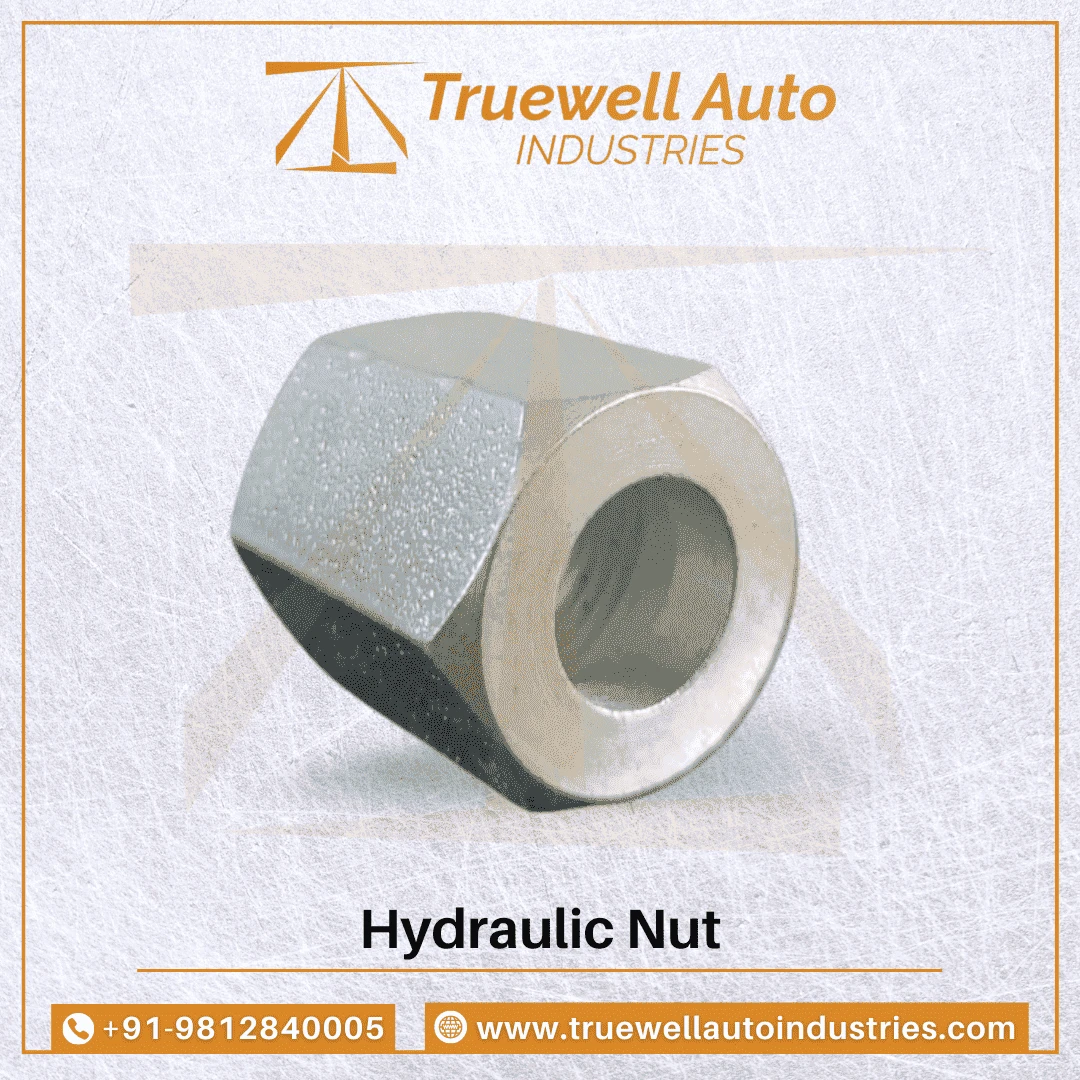
Manufactured by Truewell Auto Industries in Rohtak, Haryana, our hydraulic nuts are crafted from ultra-high-strength alloy steels with induction-hardened thrust collars and high-integrity polyurethane sealing rings designed for hundreds of repeatable cycles in extreme field environments.

